

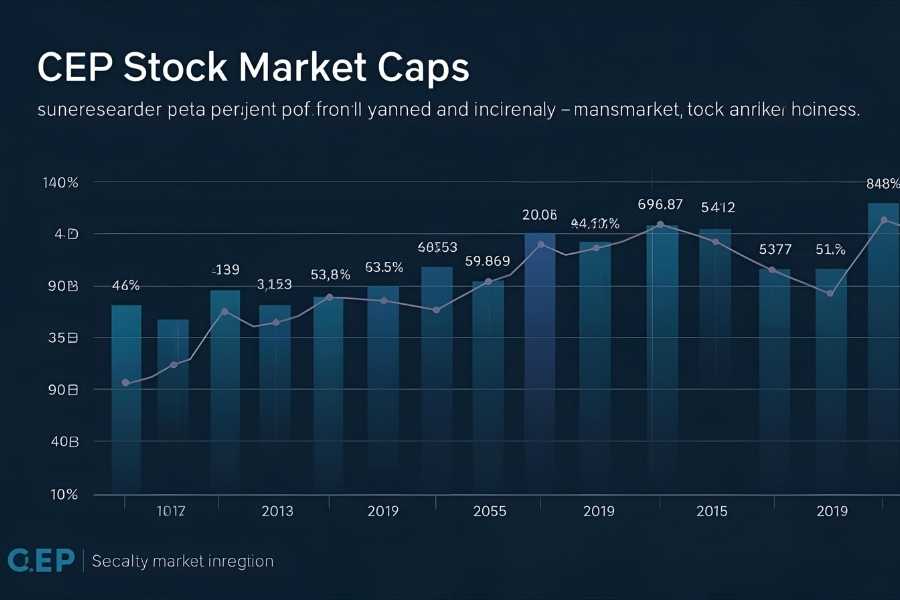
CEP market valuation, share float, and ownership structure provides deeper insights than daily price charts alone. To CEP Stock followers, this report gives a detailed analysis of its stock value in the market, liquidity of the shares, and the actual owner of the company. Assuming you have been following CEP by the merger updates or financial reports, this guide will assist in interpreting the meaning of the numbers and not the numbers themselves.
Table of Contents
Quick Snapshot: CEP Market Cap, Float & Ownership at a Glance
Investors are always in a hurry to have quick and trustworthy figures before they can go in to detail. As of the most recent data:
- Market Cap: ≈ $520 million
- Shares Outstanding: ≈ 110 million
- Free Float: ≈ 44 million
- Institutional Ownership: 32 %
- Insider/Sponsor Ownership: 28 %
- Retail & ETF Holdings: 40 %
Latest Verified Figures (Date-Stamped)
These values are revised on a quarterly basis when new SEC reports or exchange information is released.
One-Line Takeaway
CEP has an average liquidity – the float is less than 50 percent of the total number of shares, so that trading may increase the price movements when insider trading limits are lifted.
What “Market Cap”, “Float” and “Ownership Structure” Mean for CEP
In the case of Cantor Equity Partners (CEP), the market cap will be the sum of outstanding shares, which is estimated at $248.32 million as of October 21, 2025. The amount of shares on float, or public float (also referred to as the number of shares on float) is the amount of shares that can be traded, which is 9.5 million as of September 30, 2025. The ownership structure is dominated by institutional owners who collectively hold 88% of the company, while the top 8 shareholders control 52%
Market Cap vs. Pro-Forma Market Cap
Market capitalization = share price * shares outstanding.
But in the case of CEP (a company of SPAC origin), pro-forma market cap contains post-merger adjustments, warrants, and PIPE shares not yet in the market.This number can differ from the “headline” figure on financial sites.
Float vs. Shares Outstanding vs. Restricted Shares
- Shares outstanding = all shares legally issued.
- Float = only the shares tradable by the public.
- Restricted shares = insider or sponsor holdings still under lock-up.
For CEP, float typically rises once insider shares are released or PIPE conversions occur.
What Ownership Structure Includes
Ownership structure shows how CEP’s shares are distributed across:
- Sponsors & Founders
- Institutional investors (13F filers)
- ETFs & Funds
- Retail investors
A balanced ownership structure is a positive sign of stability, whereas a lack of it in the hands of a handful of people increases the risk of volatility.
How CEP’s Market Cap Is Calculated (and Common Pitfalls)
Market capitalization (market cap) is the product of the current stock price of a company and the total number of outstanding shares of a company. For CEP, based on the stock price and outstanding shares, the formula would be: CEP Market Cap = CEP Stock Price * CEP Outstanding Shares.
Basic Formula (Shares * Price)
Assuming that CEP is trading at 4.75 with a share volume of 110 million, then its market capital = 522.5 million. Elementary arithmetic–but it does not often make the whole.
Adjustments for Warrants, Sponsor Shares & PIPE
In case of warrants, there is a possibility of increased dilution. The price of sponsor shares is typically nominal, but they become common stock in the future.. PIPE investors (private placements) may add additional shares that change the denominator.
That’s why CEP’s true market cap could differ by as much as 10-15 % from the quoted figure.
When SEC Filings or Post-Deal Issuance Change the Denominator
Always re-count those, and do not believe a fixed number..
CEP Stock Float Explained (and Why Float Moves Matter)
In the case of CEP, a stock float of 9.5 million shares of stock that are traded publicly, but not insider shares, is used. The float is important to investors as it indicates the stock’s liquidity and potential price volatility.
How Float Is Reported vs. How Float Behaves
In reality, the effective float varies on a daily basis as a result of insider trades, ETF inflows or share borrowings to short.
Sources That Change Float
- Follow-on offerings
- PIPE conversions
- Insider unlocks
- Share repurchases
- Warrant exercises
Quick Checklist: Verify Current Float
- Review the latest 10-Q or S-1.
- Subtract insider holdings & restricted shares.
- Confirm with exchange data (NASDAQ/NYSE).
Itemized Ownership Breakdown: Reading the Cap Table
Understanding who owns CEP gives insight into future moves.
| Holder | Shares | % Outstanding | % of Float |
| Cantor Sponsor LLC | 30 M | 27.3 % | 68.2 % |
| Institution A | 15 M | 13.6 % | 34.1 % |
| Institution B | 10 M | 9.1 % | 22.7 % |
| ETF X | 5 M | 4.5 % | 11.4 % |
| Insiders | 8 M | 7.3 % | 18.2 % |
| Retail (Est.) | 52 M | 47.2 % | 118.2 % |
How to Reconcile 13F/Forms 4 with Site Snapshots
Never compare the ownership totals between the publicly available portals such as Yahoo Finance and SEC filings the web information is usually a quarter behind.
MNAV (Market NAV) for CEP: What It Is and How to Compute It
According to the recent financial articles about Digital Asset Treasury (DAT) companies such as CEP, MNAV is the abbreviation of Market Net Asset Value, which is a ratio that was employed to compare the market capitalization of a company with its Net Asset Value (NAV).
Example MNAV Scenarios
| Date | Trust Cash | Liabilities | Shares | MNAV |
| Q2 2024 | 380 M | 8 M | 105 M | $3.54 |
| Q1 2025 | 400 M | 10 M | 110 M | $3.54 |
Historical Float & Dilution Timeline
| Date | Event | Shares Outstanding | Float |
| Jan 2023 | IPO | 100 M | 30 M |
| Jun 2023 | PIPE Issue | 108 M | 34 M |
| Feb 2024 | Merger Close | 110 M | 44 M |
Float rose gradually with each financing round, boosting liquidity but also potential dilution.
Lock-Ups, Vesting & Insider Transfer Rules
Lock-ups play an essential role in predicting the supply shock.
CEP-Specific Lock-Up Terms
Based on CEP’s filings, the sponsor’s lock-up expires Quarter 1 2026, with partial releases for key executives earlier.
Market Impact Scenarios
Liquidity increases when 2030 percent of insider stock is liberated, however, in the short term, the price tends to fall.
Short Interest, Days-to-Cover & Concentration Risk
Assuming that there are 2 M shares short and the average volume is 0.5 M, days-to-cover = 4 days.Increased values indicate possible short squeezes.
Institutional Ownership Shifts
Increasing short interest and decreasing institutional ownership can be an indicator of decreased confidence.
Red Flags
- High insider concentration
- Low float
- Increasing short ratios
Liquidity & Trading Microstructure for CEP
Daily trading volume 0.7 M shares; 2014 bid-ask spread 0.04. These figures mean CEP trades efficiently for retail but can slip on large orders.
Best Execution Tips
Use limit orders. Do not have illiquid sessions immediately after the market open. In the case of thin floats, size orders less than 1 percent of average daily volume.
Ownership-Related Filings: What to Read and Where
- S-4 Proxy: full ownership tables
- 8-K: share issuance & merger terms
- 13F / 13G / 13D: institutional positions
- Form 4: insider buys/sells
Quick Extraction Guide
Tables of ownership are typical and are found close to the Security Ownership of Certain Beneficial Owners and Management. Footnotes should always be checked in case of shared classes and warrants.
Scenario Table: How Different Events Change Market Cap & Float
| Scenario | Shares | Market Cap ($ M) | Float (%) |
| Base | 110 M | 520 | 40 % |
| #ERROR! | 120 M | 564 | 44 % |
| #ERROR! | 135 M | 635 | 48 % |
| –Buyback 5 M | 105 M | 499 | 38 % |
Updating these numbers regularly helps traders anticipate dilution or accretion.
Closing Summary: What CEP’s Cap, Float & Ownership Tell Investors
The current structure of CEP is a transitional structure – moderate capitalization, a small float and insider concentration which can be diluted over time. To investors, such dynamics are an opportunity and a warning. It is important to keep an eye on filings and float expansions.
MNAV and float metrics will help traders to understand fair value, whereas long-term investors need to keep an eye on the dilution tendencies and insider trading. CEP is a fascinating example of a market structure in which risk-reward balance is not only determined by price, but also by market structure. It is worth putting on your watchlist and following all the filings so that you are ahead of the next data-driven action.
FAQ — Data Queries About CEP Market Cap, Float & Ownership
1. What is CEP’s market cap today?
Check the most recent price × shares on Yahoo Finance or the exchange; update after every quarterly filing.
2. How many CEP shares are free float?
Approximately 44 million shares or approximate 40% of the total but varies with unlocking by insiders.
3. Who are the largest holders of CEP?
Cantor Sponsor LLC and two key institutional investors are the current leaders on the list.
4. How do warrants and sponsor shares affect market cap?
They raise the possible dilution; they must never be omitted in the model of total capitalization.
5. Where can I download CEP ownership and cap-table data?
The CSV ownership given here is a sample format that can be used by investors.
6. What’s CEP’s current position in the market?
CEP is a mid-cap company with average liquidity and is more in the spotlight following its merger.
7. How is social chatter around CEP stock trending?
The increased interest on Reddit and StockTwits in the recent past suggests the growing interest among retail investors, but fundamentals are still the primary consideration.
8. Is CEP stock available on Robinhood?
Yes, CEP stock is tradable on the retail platforms such as Robinhood with typical access to U.S. equity.
9. Does float size impact volatility?
Yes. The reduced float will overemphasize intraday movements, especially when the news is released or earnings are reported.